
I’ve been looking forward for ages to this course and Mr. Dowding and his ‘no dig’ farm did not disappoint. Growing in just under an acre, Charles Dowding makes £30,000 a year selling salad leaves to local customers within a 4 mile radius of his farm. Very impressive!

All organically grown, successional crops of salad leaves, pea shoots and herbs can be picked all year round. With thoughtful planning, some beds will be able to produce three crops within one year. Seeds, such as endives, ‘Grenoble Red’ lettuce,
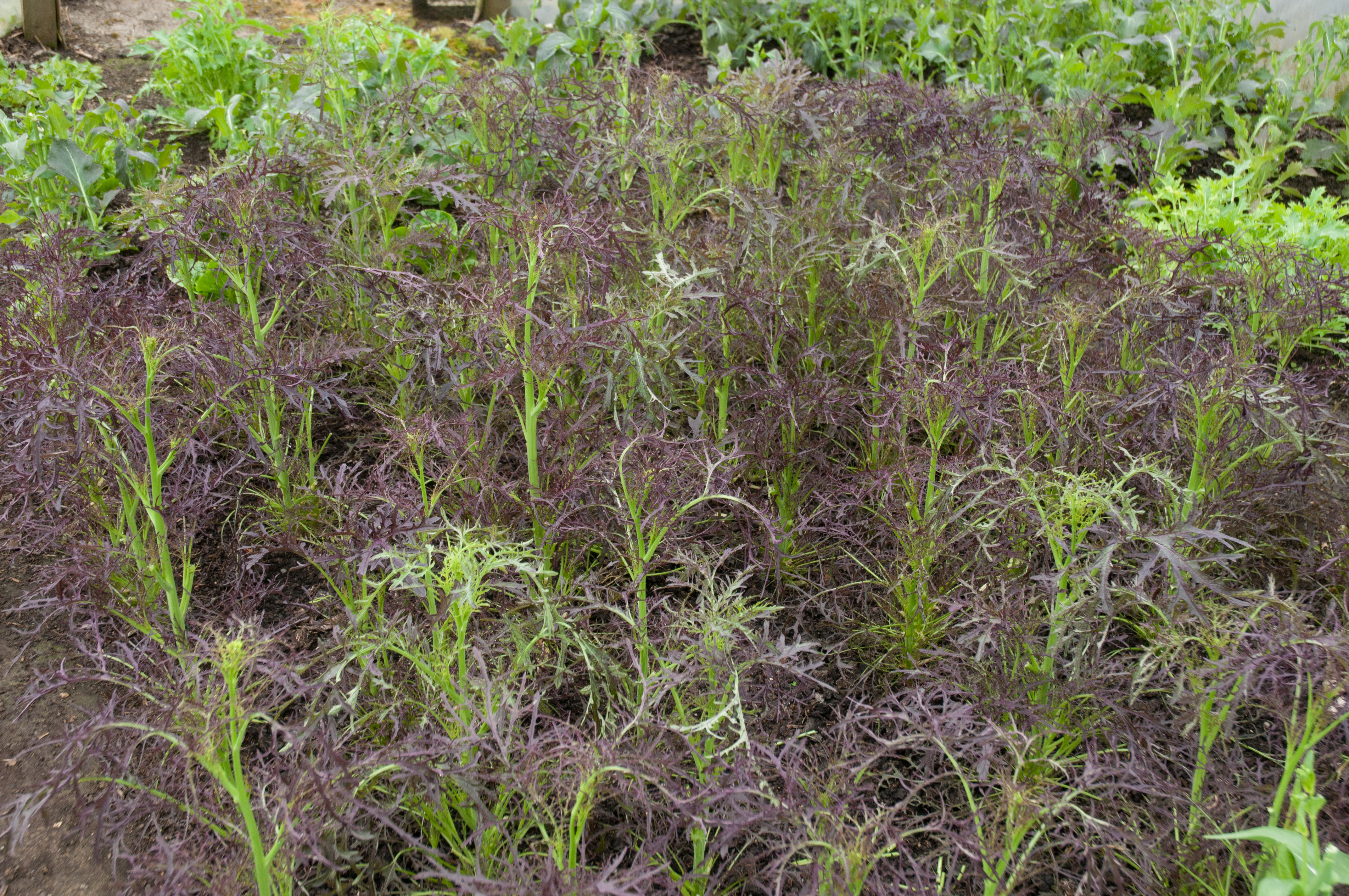
‘Red Frills’ and ‘Green in Snow’ mustard leaves are sown in September, planted out in polytunnels in October and are still cropping in April. Only outer leaves are picked, allowing the rest of the plant to continue to grow.

Charles Dowding uses no liquid or indeed pelleted feeds, but believes adding well-rotted manure or compost to the soil in between crops is enough to keep the soil in good health. By adding organic matter on top of the nutrient rich clay soil, the undug soil below retains its structure and vigilant weeding in the beds and paths provides immaculate conditions for veg to grow in.

I and fellow course attendees were encouraged to tread o the firm soil, safe in the knowledge that we would not be compacting this precious structure beneath.

As we were introduced to different production areas on the farm, I was amazed at how this small greenhouse provided enough space to start off most plants for the outside beds and two large polytunnels. Seeds are pricked out when very small into multi modular trays and kept on a heated bench for a month in February and March to produce small but strong and healthy seedlings.

Charles Dowding says he can have up to 1,500 tiny seedlings growing in his greenhouse at one time! Having a heated propagator or two at home is great, but after a couple of weeks, light levels by windows just aren’t high enough and seedlings will become leggy. Unfortunately, unless you too have a greenhouse, this type of production becomes impossible to achieve.

Having said that, these tiny modules are a revelation, and no longer will I be pricking out/potting on to such space greedy 3 inch pots.

Now every grower seems to have a bete noir in the vegetable world, and mine is beetroot. Others seem to find this the easiest of veg to grow, but for some reason I always struggle to get a decent crop. I was therefore relieved to hear that Mr. Dowding doesn’t have much success with sowing into the ground either and always starts his beetroot seeds in modules. Off to do the same as soon as this post is written!

In the outdoor beds, newly planted out leaves and other veg are all covered in horticultural fleece, not only to protect from the cold nights and wind, but also to keep pests such as rabbits, badgers and rats at bay. My urban pests, foxes and cats, are equally destructive and this duel purpose covering seems a great practice to adopt to get your veg off to a flying start.

Charles was very generous in sharing results of his many experimental practices throughout the day. On a grassy area in between apple trees, cardboard was used to cover and weaken grass for a few months. Potatoes were planted directly on top on the yellowing grass, NO DIGGING, and then well-rotted manure heaped on top. The result was plenty of potatoes! As long a 5 or 6 inches layer of soil/compost or well-rotten manure is placed on top of grass, Charles explains that planting directly on top of grass should be not be a problem, even experimenting this year with a recently constructed 6 inch raised bed for ‘Early Nantes’ carrots on top of grass. Curious to know what will happen there!
Charles Dowding is now well-known for practising and writing about the no dig gardening system and has perfected this art as well as his veg growing knowledge over many years to develop a very successful salad growing business. I picked up many growing tips during the day and will try to put some of these ideas into practise during the rest of the year. Sowing mustard leaves and hardy lettuces in August and September for winter leaves is definitely on my list, and although not a possessor of a polytunnel, I’ll be eager to see if these leaves survive outdoors in our urban climate. If I’ve learnt one thing from Mr. Dowding, it’s that it’s always worth experimenting!
Courses run on his Somerset farm throughout the summer. Well worth making the trip!

 Out of my shed
I’m doing one of his courses in April too. I can’t wait, especially after reading about your day. I’m sure there’ll be all sorts of tips to pick up.
Hi WW, yes, most definitely worth it. Hope you have a great day!
That sounds like a really inspirational day (and the small module thing is a great tip, thanks).
I know some people near me who are fans of the no-dig approach, and I have to say that they struggle…. but having read your post, I’m not sure they’re really following in the master’s footsteps. I’d love to give this a go, but I’m not sure I’m brave enough. I have a feeling I’d just end up with couch grass.
Hi Kate, I think to run the no dig system, you need heaps of space to rot down plenty of compost and horse and cow manure, otherwise you’d have to buy in large quantities of organic matter. Also patience and time needed to start up new beds by covering or by building 6 inch raised beds. Charles did say that covering grass (with a min. of 4 or 5 inches of compost) will eventually weaken and kill off couch grass and other nasties such as dandelion and his established beds certainly were looking immaculate and weed free.
Space is always at a premium in our urban setting, but will certainly attempt not to dig wherever possible in future, not only to protect the soil structure, but also to protect my back!
Great post! I’m a big fan of Charles Dowding and have his books – I didn’t know he ran these courses too. I’m going to give no-dig gardening my best shot this year, if all goes to plan, but I just can’t do it with the potatoes – buying in all that manure or compost is way too expensive!
Hi Naomi, yes, unless you have easy access to oodles of compost or manure, potatoes a la no dig could prove a little costly. Might just try it out just with a couple of tubers this year to see how successful it is. Hope you have a productive year!
I like the “spuds on grass” idea; I’ll be giving that a try!!!
Hi IG, yes, might give this a go too. Do let me know how it works out.
V.best Naomi
Great post, most informative and inspiring–and great photos, as ever. Thank you Naomi.
Thanks Jane!
The idea of weakening the grass and then starting a bed on it without digging is quite mindblowing: and possibly one I’d thought of before digging over a huge turfed allotment by hand at the start of this year. Still I have very strong arms now! I am also hugely jealous of his greenhouse as my windowsills really aren’t enough for the level of growing that I do.
Hi F&F, I’m very envious of Charles’ greenhouse too! The more I mull over my visit and the course, the more I realise that no dig and year round cropping do require a few ‘musts’. Time and space are essentials. Space for storing and rotting down manure (and a handy supply of said manure v.useful too). Space to have a polytunnel! Time for nature to break down manure on beds to form a fine tilth. (Charles like to spread manure on his beds by Christmas, so that they’re in good shape to use for early spring). Also not forgetting time and energy to build 6 inch raised beds if you’re going to plant crops straight over grass. Charles Dowding has built up his beds over many years, so maybe a tad of patience too!
I created a whole no dig vegetable garden of 10 4 ft wide beds last March (2011) directly onto grass, which was producing abundantly by early summer. That required a 6 inch depth of compost to kill off the grass (I sowed potatoes directly onto it the grass, too) but you don’t need 6 inches if you have bare earth.
Charles’ beds are just a couple of inches or so above the paths.
A tilth can be created by breaking down lumps with a copper edger or rake if you are not able to spread manure before the winter, so it can still be done now.
Friends who have smaller gardens with no space for a manure pile have bought well rotted manure and applied it immediately to their beds, mostly bought in sacks. Space for a domestic compost bin is always useful! A good supply of manure or compost is needed whether one digs or not, so I have found that I haven’t used any more than my digging allotment neighbours. I do have a lot fewer weeds and really good vegetables though!
I have had great success with salads grown in an exposed allotment over winter under a cloche made from 30 gsm fleece – I couldn’t pick when there was heavy snow but was able to pick enough salad for a family of 4 throughout the winter, right up to the spring sown salads being ready, using this method. A good alternative is to make a cloche from polytunnel or builders’ plastic, which does not degrade in sunlight and so can be reused many times.
Thanks Stephanie for such a great reply.Good to hear how well the No Dig system can work.Definiteldy planning on growing potatoes on top of grass this year and will mulch and hoe rather than dig to weed existing beds.Hope you have a great growing season à la no dig. V.best Naomi
A really interesting post, thank you.
Thanks Claire.
A great read – thanks. I am currently a minimum digger rather than a no digger. As we have clay soil, the more you dig the worse it gets. We just put lots of homemade compost on top and it seems to work!
Hi WCGs, as a gardener with clay soil, I quite agree-no dig seems like the best option.Love your metal planters for salad leaves and definitely have spacious greenhouse envy! Thanks for dropping by. Naomi
Naomi you have a great blog here and lots of keen gardeners responding; as Steph says, you don’t need more organic matter than when digging, except at the beginning, and the first thicker dressing is a long term investment to create soil rich enough for abundant growth. Vegetables are Olympic athletes, give them top facilities and they go for gold! Especially in undug soil.
Hi Charles, thanks so much for your comments. Yes, lots of keen gardeners very enthusiastically getting into the groove of no dig. Like F&F, wish I’d been more aware of this process years ago when starting off my allotment beds, but will be embracing ‘no dig’ from now on. Makes so much sense. Just getting out of old digging habits, especially when weeding perennials, takes a small shift in thinking, but I’m getting there! Off to plant a potato bed on grass this weekend and already very excited about seeing some Olympic spuds come summer! V.best Naomi
Great post, I’ll definitely be sharing it!
Thanks Adele!
Sounds like a wonderfully informative day and well worth the trip down to Devon (I think that’s where CD farms). Having first hand access to the information is so energising – you’ve definitely come back with more than a spring in your step! I’m a part no digger as I don’t want to bring weeds up to the surface and prefer to let the worms take mulch back down into the soil but we still have more than a few roots to dig out whilst hoeing will take care of the rest. Lovely post and wish your Olympic spuds well!
Hi Caro
Yes, was a great day, plus forgot to mention, a delicious lunch for all of us, lovingly prepared by Charles’ wife too. Have just planted some Charlotte potatoes straight onto grass. Overly excited about this experiment and off to plant some Pink Fir Apples on grass at my allotment next week too. Happy days! N x
A great blog Naomi.
I too have started no dig this season having acquired a 5 rod allotment and was bemoaning the lack of a greenhouse, however I have found that I can start things on a window sill and once germinated move them in to a grow house.
I have a 4 tier one which I think cost about £30 secured to a west facing wall of my house and whilst it has been a bit of juggling act it has helped a lot in producing plug plants of a size to go out and fend for themselves. I plant in to half size module trays, which sit up to 6 per shelf. They do need to be juggled about a bit so tehy all get some light, especially with the total lack of sun over the last month.
In London you could probably grow in it most of the year as I have had tomato plants in there for over a month now and so long as the temperature is not negative they are fine. On the one night it was expected to go down to -1 I bottled out and added some fleece to keep them snug.
I fully intend to try a box of salads over winter in there.
Hi Jan, yes, lots of juggling as seedlings get bigger, but mini greenhouses are a great solution if there’s no room for a greenhouse proper. Will be really experimenting with winter leaves this year. Have mostly put all my efforts in spring production up until now, but will be sowing plenty of lettuces, mustard leaves and possibly violas at the end of summer for winter salads. Wrote a post about Food from the Sky in January where they had very impressive yields of winter leaves. Also very inspiring! Thanks for great comment. Naomi
[…] seed potatoes when I got back from my Easter holiday, and inspired by Charles Dowding growing potatoes straight onto grass, I decided to give this a go. Now I do remember Charles […]
[…] edible success was growing potatoes on top of grass. Following my visit to Charles Dowding’s ‘no dig’ farm, I experimented with a few Charlotte potatoes […]
[…] And Charles Dowding is offering ‘no dig’ courses from January at his new farm in Somerset. Really worth the trip as I discovered earlier this year. […]
Great information. Wish I could pop over for the January course. Thanks.
Thanks Erica. It was a truly inspirational day and I’d certainly recommend ‘popping over’ to meet Charles Dowding later in the year if you can. Following the course, I grew potatoes on top of fresh grass, a la ‘no dig’ last year and was delighted with my harvest. Planning on a few more ‘no dig’ experiments for springtime this year too. Thanks for dropping by. V.best Naomi
[…] in just under an acre, Charles Dowding makes £30,000 a year selling salad leaves to local customers within a 4 mile radius of his […]
[…] in spring last year I went to visit Charles Dowding on his well-established ‘No Dig’ farm in Somerset. I’d read his books on ‘No Dig’ gardening, packed full of useful advice and […]
I have been a fan of Charles since his first book came out. We too grow on an acre of clay, we have a small green house, a polytunnel, a 30 tree orchard and only use no dig techniques. 11 years we have been doing this and people are always amazed at the productivity of our garden. This year we have over produced for our family and have been selling the excess. I am still learning though! Great blog by the way. Nick
Hi Nick, Very envious of a whole acre for gardening. Sounds very productive and very rewarding. Thanks for dropping by. V.best Naomi
I’ve watched literally hundreds of Back To Eden and No-Dig You Tube videos and Charles Dowding’s are the best, especially because he’s in the UK. A year ago, with ailing fruit trees and fighting weeds, I finally bit the bullet and mulched around the grass under a large-ish apple tree with my own compost and a pile of woodchips plus used rabbit hay with poops. The apples had been getting progressively less edible over the few years we’ve been here, most of them attacked by bugs. Last summer, we had many, many more, huge apples, of much better quality and the tree is looking happier. I also underplanted, randomly (a la Back To Eden) a new batch of strawberries and they have thrived, even on the “wrong” side of the tree. The soil never dried out, I didn’t have to water (much) and weeding was a breeze compared to everywhere else in this garden. This soil can be walked on and doesn’t compact. We are on the west coast of Scotland a little bit back from the river, near the sea outlet, which means we do have a coastal element to factor in, not least strong winds and a lot of rain and cold. I did the same with artichokes and they were effortless. I’ve not dug any up and hope they are OK out there, but they grew tall and strong. I grew blight resistant potatoes in ten 30l pots (another You Tube video) and that was a resounding success). All pesticides, herbicides, fungicides and artificial fertilizers have been banned and my husband has been schooled in how to love the mushrooms growing on the lawn he has been trying to perfect for years :). We will be placing an order for a large quantity of rock minerals in due course. The old wooden greenhouse in the garden finally had to be dismantled, the glass being snapped up by an allotmenteer via Freecycle, and I have a new one to go up. I will probably use a greenhouse heater, but have seen the wonderful idea of heating greenhouses and polytunnels with compost piles – perhaps that’s for another year. Having struggled with gardening and having two failures for every one success, I am flabbergasted at how easy it actually is and realise now just how little I have ever learned from being a member of a horticultural society, whose members seem to be experts in growing onions, leeks and dahlias and who would probably be horrified at the turn of events in my hidden walled area at the side of the house with cardboard boxes over the grass and random piles of every composting material I can lay my hands on. I wish I’d known years ago it could be this easy. Perfectionist as I am, I will probably move the strawberries, more so that I can protect them from the birds and plant rhubarb and comfrey around the trees. I envy (in a nice way) Charles’ perfect beds – one day … The adventure has just begun :).